|
|
|
|
Watts Happening?
Please find below our latest issue of Watts Happening?, a market update highlighting key developments across power markets. Our analysis is based on public data and reflects our current views.
|
|
Market Update: Illinois Power Prices — The Same Power. A Bigger Bill.
|
|
Rising power costs are being felt across the economy. Our last newsletter focused on households. Today, we turn to large industrial power users.
|
Industrial customers still pay roughly half the residential rate nationally. In Illinois, the spread versus residential reached 9.26 cents per kWh in the first half of 2026 — the widest first-half gap since 2001.
|
Industrial bills could climb further if that spread returns to historical levels through industrial prices catching up. The scenarios below show what that could mean for Illinois power users.
|
- Home: $1,625 per year
- Business: $10,058 per year
- Large industrial user: $770,783 per year
|
*Full-year estimates at average Illinois electricity use.
|
Industry Pays Less Than Homes
|
|
The spread versus residential is 9.27 cents per kWh in our 2026 estimate. The 10-year average is 6.64 cents.
|
|
If that gap shrinks while residential prices stay the same, industry pays more.
|
|

|
|
A Smaller Gap. A Bigger Bill.
|
|
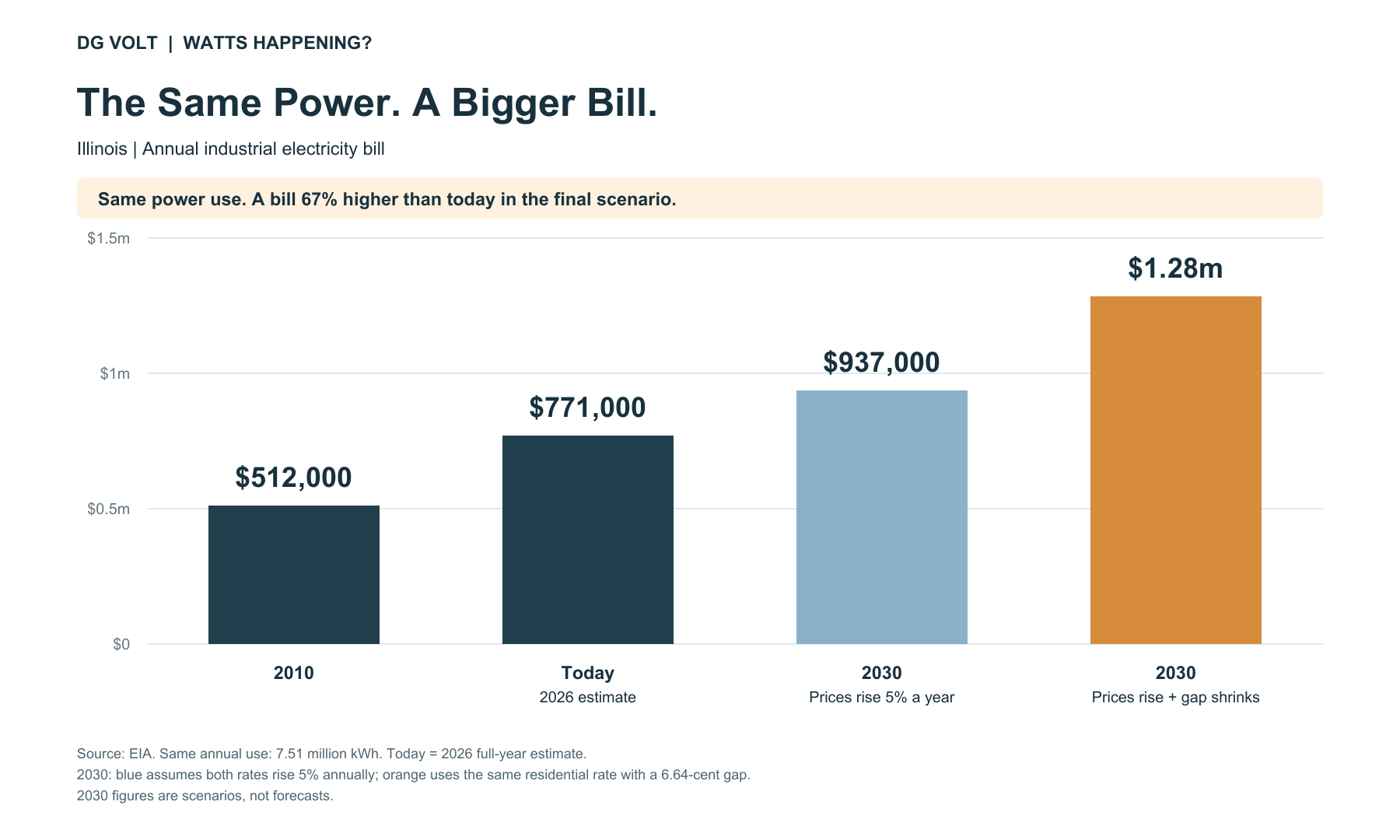
At today’s estimated residential price, a return to the historical spread would raise the industrial bill from $770,783 to $968,532.
|
Same power use. Nearly $198,000 more per year.
|
|
At 5% annual price increases, the industrial bill reaches $937,000.
|
|
If residential prices follow that path and the spread returns to its historical average, the industrial bill reaches $1.28 million — 67% more than today.
|
|
The future is unknown. Planning for higher power costs makes sense.
|
|
|
|
Take Control of Rising Power Costs
|
Battery storage lets you buy power when it costs less and use it when prices rise —including during afternoon peaks. For large power users, that can mean lower peak charges and less exposure to expensive electricity.
|
|
Batteries also add capacity when the grid needs it most, easing strain and helping lower costs across the system.
|
No fuel burned. No direct operating emissions. No water used to generate electricity.
|
|
The cost tidal wave is rising. Battery storage can help reduce its impact.
|
Put your power bill to work. Contact DG Volt to explore how battery storage could lower your costs.
|
Source: EIA. 2026 estimates apply January–June’s year-over-year price increases to a full-year baseline. Annual use stays fixed: home 8,316 kWh; business 70,848 kWh; industrial 7,508,604 kWh, based on EIA’s 2024 Illinois customer averages. Historical spread: average residential minus industrial price, 2016–2025. The 2030 figures are scenarios, not forecasts.
|
Feel free to share this with a colleague or friend. Click here to subscribe.
|
|
|
|
|
|
|
|